
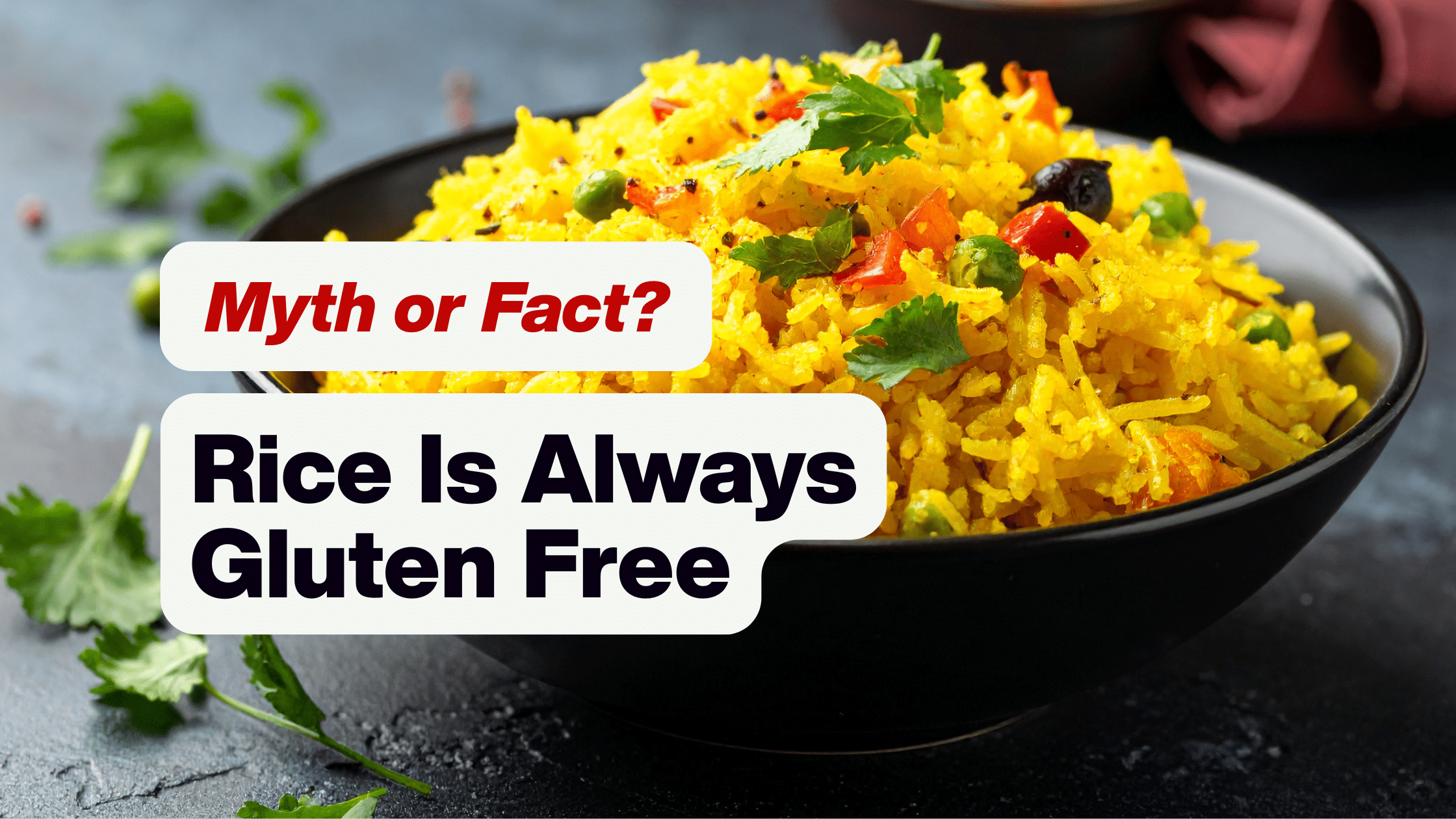
Rice is one of the most trusted staples in the gluten-free diet. It’s widely available, naturally free of gluten, and for most people with celiac disease or gluten sensitivity, it’s a daily cornerstone.
So — myth or fact: is rice always gluten free?
The grain itself: yes. But the science around rice and contamination is more layered than that, and worth understanding if you depend on a strictly gluten-free diet.
Rice is naturally gluten free — all varieties
Gluten is a protein composite found in wheat, barley, and rye. Rice contains none of these proteins. All varieties — white, brown, basmati, jasmine, arborio, parboiled — are inherently gluten free.
This includes glutinous rice, also called sticky rice or sweet rice. Despite the name, it contains no gluten. “Glutinous” describes its sticky texture — a result of its high amylopectin starch content — not its protein composition (Beyond Celiac).
What the testing data says about whole rice
Multiple independent studies support the safety of whole, unprocessed rice.
A 2025 peer-reviewed study by researchers at the University of Zagreb (Bituh et al., Food Technology and Biotechnology) tested 41 commercial rice samples — white, brown, and parboiled — from producers in Italy, Pakistan, India, France, and the wider EU. Using a validated ELISA method with a detection limit of 5 mg/kg, the researchers detected no gluten in any of the 41 samples.
A 2010 U.S. pilot study by Thompson, Lee, and Grace (Journal of the American Dietetic Association) tested 22 inherently gluten-free grains, seeds, and flours and found no gluten contamination in rice specifically — though other naturally gluten-free grains, including millet and buckwheat, tested positive.
In its whole, unprocessed form, rice has shown no detectable gluten in studied samples.
Where the risk enters: milling, processing, and handling
“Naturally gluten free” describes what a grain is — not how it was grown, milled, stored, or packaged. Once rice enters commercial processing, the risk picture changes.
A 2013 Health Canada study (Koerner et al., Food Additives and Contaminants) analyzed 640 samples of naturally gluten-free flours and starches purchased in eight Canadian cities. Brown rice flour samples contained gluten levels ranging from 6 to 1,485 mg/kg — far above the 20 mg/kg international gluten-free threshold. Among unlabeled naturally gluten-free flours and starches, about 15% exceeded 20 mg/kg – compared to just 1.1% of those labeled gluten free. The primary driver: shared milling equipment with wheat, barley, or rye.
A 2017 Italian study (Verma et al., Nutrients) examined 200 gluten-free products in Italian supermarkets, including 24 rice products. One exceeded 20 mg/kg — and notably, no certified gluten-free products in the study exceeded the threshold.
Most recently, a 2025 Turkish study published in Frontiers in Nutrition (Öcal & Özel) tested 163 flour samples across certified, packaged, and unpackaged categories. Among uncertified rice flour samples, 28.6% exceeded 20 mg/kg. Among certified gluten-free rice flour samples: none exceeded the threshold.
The pattern is consistent across countries and study designs: the grain is not the problem. The processing environment is.
The cooking environment matters too
Contamination risk doesn’t end at the factory. A 2021 study by Vukman et al. (Food Control) found that a rice-based risotto — prepared with rice that individually tested below 20 mg/kg — resulted in an estimated gluten exposure of 3.45 mg per serving, highlighting how preparation conditions can affect total exposure.
A single portion of rice prepared in a non-dedicated kitchen can still deliver a few milligrams of gluten, even when the rice itself is clean.
Beyond Celiac documents similar real-world risks: shared scoops in grocery bulk bins, shared pans in restaurant kitchens, and pre-seasoned or pre-cooked rice products where added ingredients may contain gluten.
A labeling nuance worth knowing
In the European Union, plain rice is recognized as naturally gluten‑free, but a “gluten‑free” claim is usually not applied to single‑ingredient foods like rice. Under EU Regulation 828/2014, using the claim on a naturally gluten‑free food may be considered unnecessary and should not mislead consumers by implying a special property when similar products are inherently gluten‑free. In practice, this means that the absence of a “gluten‑free” label on plain rice is usually a matter of labelling rules, not a hidden risk.
Where the label does matter is on processed products: rice flour, pasta, pre-seasoned blends, and packaged rice-based foods, where the production process — not the raw grain — determines whether the final product is safe.
The global standards picture
Different countries set different thresholds for gluten-free claims. The international Codex Alimentarius standard — followed by the US, Canada, UK, and EU — sets the limit at ≤ 20 ppm. Japan applies a 1 ppm voluntary standard specifically to rice flour. Australia and New Zealand maintain a “no detectable gluten” requirement, currently equivalent to approximately 3 ppm depending on the test method.
That Japan — a rice-centric food culture — introduced a dedicated standard for rice flour specifically is itself a signal: even where rice dominates the diet, the industry recognizes that milled rice warrants its own safety framework.
A 2022 systematic review and meta-analysis published in the British Journal of Nutrition (Guennouni et al.) synthesized 40 studies from across the globe and found an overall gluten contamination prevalence of 15.12% in tested gluten-free products — a reminder that the label alone is not a guarantee.
What certification actually changes
The data from multiple countries points to the same conclusion: third-party certification is associated with lower contamination rates.
- Turkey 2025: 0% of certified gluten-free rice flour samples exceeded 20 mg/kg — versus 28.6% of uncertified samples.
- Canada 2013: Only 1.1% of labeled gluten-free products were contaminated — versus 15.6% of unlabeled naturally gluten-free flours.
- Italy 2017: 0% of certified products exceeded the threshold.
Certification doesn’t change the grain. It controls the environment: the equipment, the protocols, the testing frequency, and the documentation. For people with celiac disease who rely on processed rice products daily, that difference is material.
GFFP-certified rice products
The following brands currently hold Gluten-Free Food Program (GFFP) certification, verified at ≤ 5 ppm — four times stricter than the international 20 ppm standard:
- Cuisine l’Angélique — La Merveilleuse All-Purpose Flour
- It’s That Simple — Brown rice, white rice, chili-infused, and turmeric-infused rice blends
- Tinkyada — Brown and white rice pasta in multiple varieties, produced in a dedicated single-grain facility
All can be found at gf-finder.com.
The verdict
Rice, in its natural form, is gluten free. The science on whole rice is consistent and reassuring across multiple independent studies. But “naturally gluten free” is a statement about a grain — not about a supply chain. Once rice is processed into flour, pre-seasoned, pre-cooked, or packaged in a shared facility, the risk picture changes in ways the grain itself cannot prevent.
For people with celiac disease who eat rice and rice products daily, understanding where contamination risk enters — and what controls reduce it — is what turns “naturally gluten free” into actually safe.
This article is for educational purposes and does not constitute medical or dietary advice. Individuals with celiac disease should consult a registered dietitian or gastroenterologist for personalized guidance.